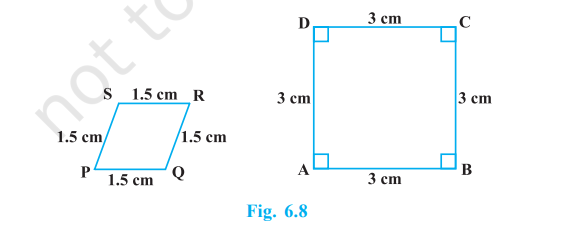
1. Fill in the blanks using the correct word given in brackets :
(i) All circles are similar.
(ii) All squares are similar.
(iii) All triangles are not similar (only if equilateral then yes). (Here the intended answer is “equilateral” triangles are always similar.)
(iv) Two polygons of the same number of sides are similar if:
2. Give two different examples of pair of
(i) Examples of similar figures: two circles of different sizes, two squares of different sizes.
(ii) Examples of non-similar figures: a circle and a square, a rectangle and a triangle.
1. In Fig. 6.17, (i) and (ii), DE || BC. Find EC in (i) and AD in (ii).
Apply the Basic Proportionality Theorem (BPT):
If a line is drawn parallel to one side of a triangle, intersecting the other two sides at distinct points, then the line divides those two sides in the same ratio.
In this case, DE || BC. Therefore, by BPT, AD/DB = AE/EC.
Substitute the given values:
So, 1.5 / 3 = 1 / EC.
Solve for EC:
Multiply both sides by EC to get: 1.5 × EC = 3.
Divide both sides by 1.5: EC = 3 / 1.5.
EC = 2 cm.
Conclusion: Therefore, EC = 2 cm.
2. E and F are points on the sides PQ and PR respectively of a ΔPQR. For each of the following cases, state whether EF || QR :
(i) PE = 3.9 cm, EQ = 3 cm, PF = 3.6 cm and FR = 2.4 cm
(ii) PE = 4 cm, QE = 4.5 cm, PF = 8 cm and RF = 9 cm
(iii) PQ = 1.28 cm, PR = 2.56 cm, PE = 0.18 cm and PF = 0.36 cm
Solution:
Identify the given values:
Calculate the ratio of PE to EQ:
PE / EQ = 4 / 4.5 = 8 / 9
Calculate the ratio of PF to FR:
PF / FR = 8 / 9
Compare the ratios:
PE / EQ = PF / FR = 8 / 9
Apply the converse of the Basic Proportionality Theorem:
If a line divides two sides of a triangle in the same ratio, then the line is parallel to the third side.
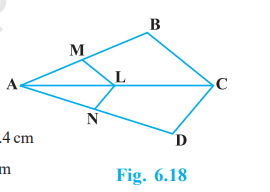
3. In Fig. 6.18, if LM || CB and LN || CD, prove that
AM/AN = AB/AD
Solution:
In the diagram, if we have a triangle ABC and a line DE such that D lies on AB and E lies on AC, and AD/DB = AE/EC (or AD/AB = AE/AC), then we can use the Basic Proportionality Theorem (BPT) to prove that DE is parallel to BC.
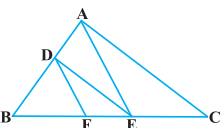
AD/DB = AE/EC, we can use the converse of the BPT to conclude that DE is parallel to BC.4. In Fig. 6.19, DE || AC and DF || AE. Prove that
BF/BE = FE/EC
Given Information: In triangle PQR, points E and F are on sides PQ and PR respectively.
Applying the Converse of Basic Proportionality Theorem: To prove that EF is parallel to QR, we need to show that PE/EQ = PF/RF.
Calculating Ratios:
Comparing Ratios: Since 1.3 ≠ 1.5, the ratios are not equal.
Conclusion: According to the Converse of Basic Proportionality Theorem, EF is not parallel to QR.
Therefore, the answer to question 4 in Exercise 6.2 is that EF is not parallel to QR.
5. In Fig. 6.20, DE || OQ and DF || OR. Show that EF || QR.
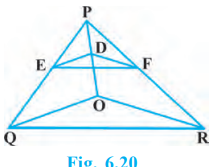
Given:
To prove: EF || QR
Proof:
Conclusion: Hence, EF is parallel to QR.
6. In Fig. 6.21: A, B, and C are points on OP, OQ, and OR respectively such that AB || PQ and AC || PR. Show that BC || QR.
Proof:
Hence proved: BC || QR
7. Using Theorem 6.1, prove that a line drawn through the mid-point of one side of a triangle parallel to another side bisects the third side.
Given: Triangle ABC with D as midpoint of AB and line DE || BC.
To Prove: E is midpoint of AC.
Therefore: A line through midpoint and parallel to another side bisects the third side.
8. Using Theorem 6.2, prove that the line joining mid-points of any two sides of a triangle is parallel to the third side.
Given: Triangle ABC with D and E as midpoints of AB and AC respectively.
To Prove: DE || BC
Therefore: DE is parallel to BC.
9. ABCD is a trapezium where AB || DC and diagonals intersect at point O. Show that:
AO / CO = BO / DO
Proof:
Hence proved.
10. The diagonals of quadrilateral ABCD intersect at O such that:
AO / CO = BO / DO
Show that ABCD is a trapezium.
Proof:
Therefore: ABCD is a trapezium.
6. In Fig. 6.21: A, B, and C are points on OP, OQ, and OR respectively such that AB || PQ and AC || PR. Show that BC || QR.
Proof:
Hence proved: BC || QR
7. Using Theorem 6.1, prove that a line drawn through the mid-point of one side of a triangle parallel to another side bisects the third side.
Given: Triangle ABC with D as midpoint of AB and line DE || BC.
To Prove: E is midpoint of AC.
Therefore: A line through midpoint and parallel to another side bisects the third side.
8. Using Theorem 6.2, prove that the line joining mid-points of any two sides of a triangle is parallel to the third side.
Given: Triangle ABC with D and E as midpoints of AB and AC respectively.
To Prove: DE || BC
Therefore: DE is parallel to BC.
9. ABCD is a trapezium where AB || DC and diagonals intersect at point O. Show that:
AO / CO = BO / DO
Proof:
Hence proved.
10. The diagonals of quadrilateral ABCD intersect at O such that:
AO / CO = BO / DO
Show that ABCD is a trapezium.
Proof:
Therefore: ABCD is a trapezium.
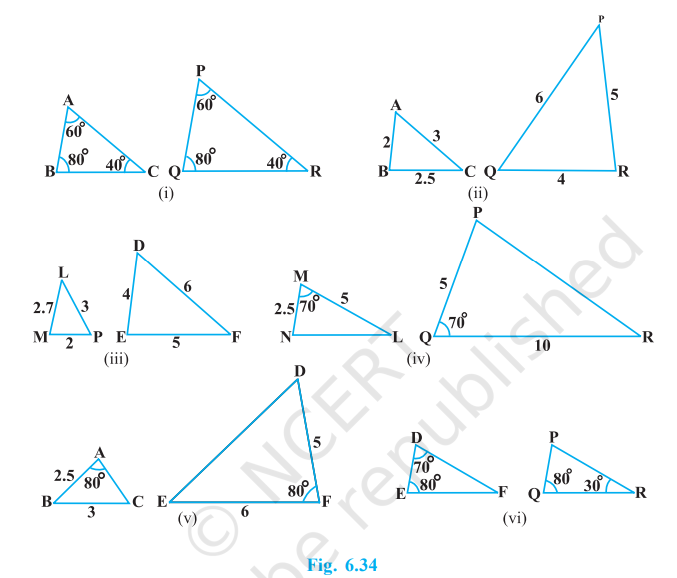
Example (i):
In ΔABC and ΔPQR:
∠A = ∠P = 60°, ∠B = ∠Q = 80°, and ∠C = ∠R = 40°
All corresponding angles are equal.
ΔABC ~ ΔPQR by AAA similarity.
Example (ii):
In ΔABC and ΔPQR:
AB / QR = 2 / 4 = 1/2
BC / RP = 2.5 / 5 = 1/2
AC / PQ = 3 / 6 = 1/2
All sides are in proportion.
ΔABC ~ ΔPQR by SSS similarity.
Given: ΔODC ~ ΔOBA, ∠BOC = 125° and ∠CDO = 70°
To find: ∠DOC, ∠DCO, and ∠OCD
Solution:
Since ΔODC ~ ΔOBA, we know that:
∠DOC = ∠BOA (corresponding angles)
∠DCO = ∠OAB (corresponding angles)
∠OCD = ∠OBA (corresponding angles)
We also know that ∠BOC = 125° and ∠CDO = 70°.
To find ∠DOC, we can use the fact that the sum of angles in a triangle is 180°.
∠DOC = 180° - ∠BOC - ∠DCO
∠DOC = 180° - 125° - 70°
∠DOC = 180° - 195°
∠DOC = 5°
Therefore, ∠DOC = 5°.
Similarly, we can find ∠DCO and ∠OCD.
∠DCO = 180° - ∠BOC - ∠DOC
∠DCO = 180° - 125° - 5°
∠DCO = 50°
∠OCD = 180° - ∠BOC - ∠DCO
∠OCD = 180° - 125° - 50°
∠OCD = 5°
Therefore, ∠DOC = 5°, ∠DCO = 50°, and ∠OCD = 5°.
Given: Diagonals of trapezium ABCD intersect at O, with AB || DC.
To prove: OA/OC = OB/OD
Proof:
Therefore: OA/OC = OB/OD
QR / QT = QS / PR and ∠1 = ∠2.
Show that ΔPQS ~ ΔTQR.
We are given the following:
Now consider triangles PQS and TQR:
So, the triangles have one angle equal and the sides including those angles in the same ratio.
Therefore, by SAS (Side-Angle-Side) similarity criterion:
ΔPQS ~ ΔTQR
It is given that ∠P = ∠RTS.
Show that ΔRPQ ~ ΔRTS.
Given: ∠P = ∠RTS, and S and T are points on sides PR and QR respectively of triangle PQR.
Consider triangles RPQ and RTS.
So, both triangles have two corresponding angles equal.
Therefore, by AAA (Angle-Angle-Angle) similarity criterion:
ΔRPQ ~ ΔRTS
Given: ΔABE ≅ ΔACD
To prove: ΔADE ~ ΔABC
Proof:
Therefore: ΔADE ~ ΔABC
(i) ΔAEP ~ ΔCDP
(ii) ΔABD ~ ΔCBE
(iii) ΔAEP ~ ΔADB
(iv) ΔPDC ~ ΔBEC
We know that if two triangles are congruent, then their corresponding parts are equal.
If one angle of a triangle is equal to one angle of another triangle and the sides including these angles are proportional, then the triangles are similar. This is known as the SAS (Side-Angle-Side) similarity criterion.
In ∆ABE and ∆ACD:
Now, consider ∆ADE and ∆ABC:
Therefore, by the SAS similarity criterion:
∆ADE ~ ∆ABC
We are given that ABCD is a parallelogram and E is a point on the extension of side AD. Line BE intersects CD at F.
To prove: ∆ABE ~ ∆CFB
Now, in ∆ABE and ∆CFB:
So, by AA (Angle-Angle) similarity criterion:
∆ABE ~ ∆CFB
If two angles of one triangle are respectively equal to two angles of another triangle, then the two triangles are similar. This is known as the AA (Angle-Angle) similarity criterion.
In triangles ΔABC and ΔAMP:
Therefore, by the AA criterion,
ΔABC ∼ ΔAMP
Since the triangles are similar, the ratios of their corresponding sides are equal.
Thus, in ΔABC and ΔAMP:
CA / PA = BC / MP
(i) CD divided by AC equals GH divided by FG.
(ii)Triangle DCB is similar to triangle HGE.
(iii)Triangle DCA is similar to triangle HGF.
(iv)Triangle DCA is similar to triangle HGF.
We have angle bisectors:
given statement
Since CD and GH are angle bisectors, they divide their respective angles into two equal parts. When we have angle bisectors, they create similar triangles.
Given that ∠BDC = 50°, and triangle DCB is similar to triangle HGE (from statement ii), this means that ∠HGE would also be 50°.
Therefore, ∠HGE = 50° is the answer to this geometry question
Given:
To Prove: ΔABD ~ ΔECF
Proof:
In triangle ABC, sides AB, BC, and median AD are respectively proportional to sides PQ, QR, and median PM of another triangle PQR. Show that ΔABC ∼ ΔPQR.
Given:
To prove: ΔABC ∼ ΔPQR